
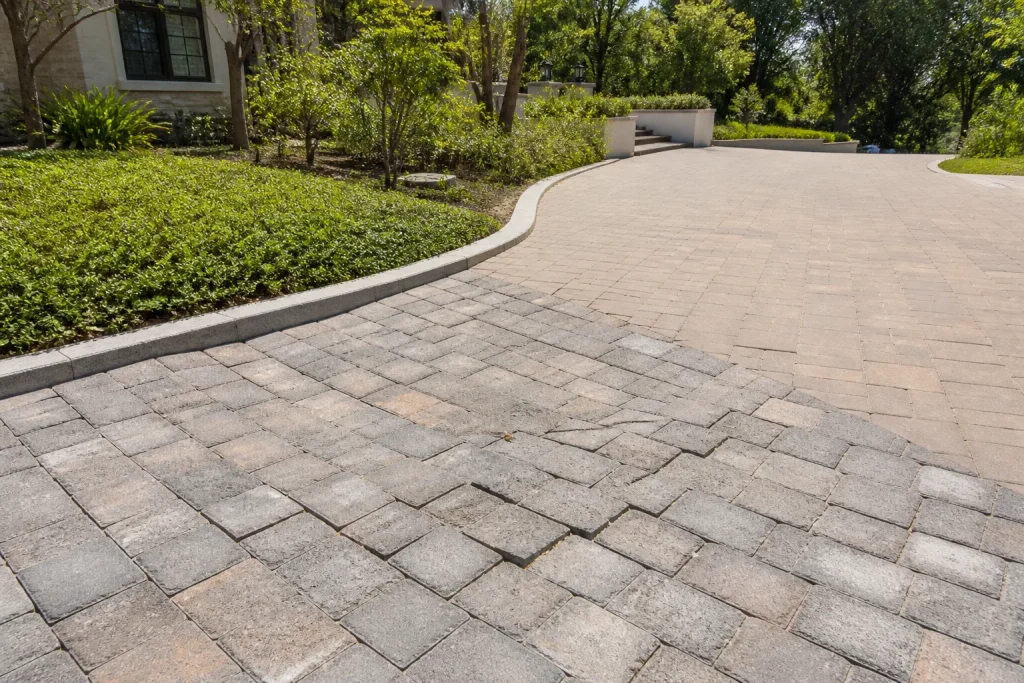
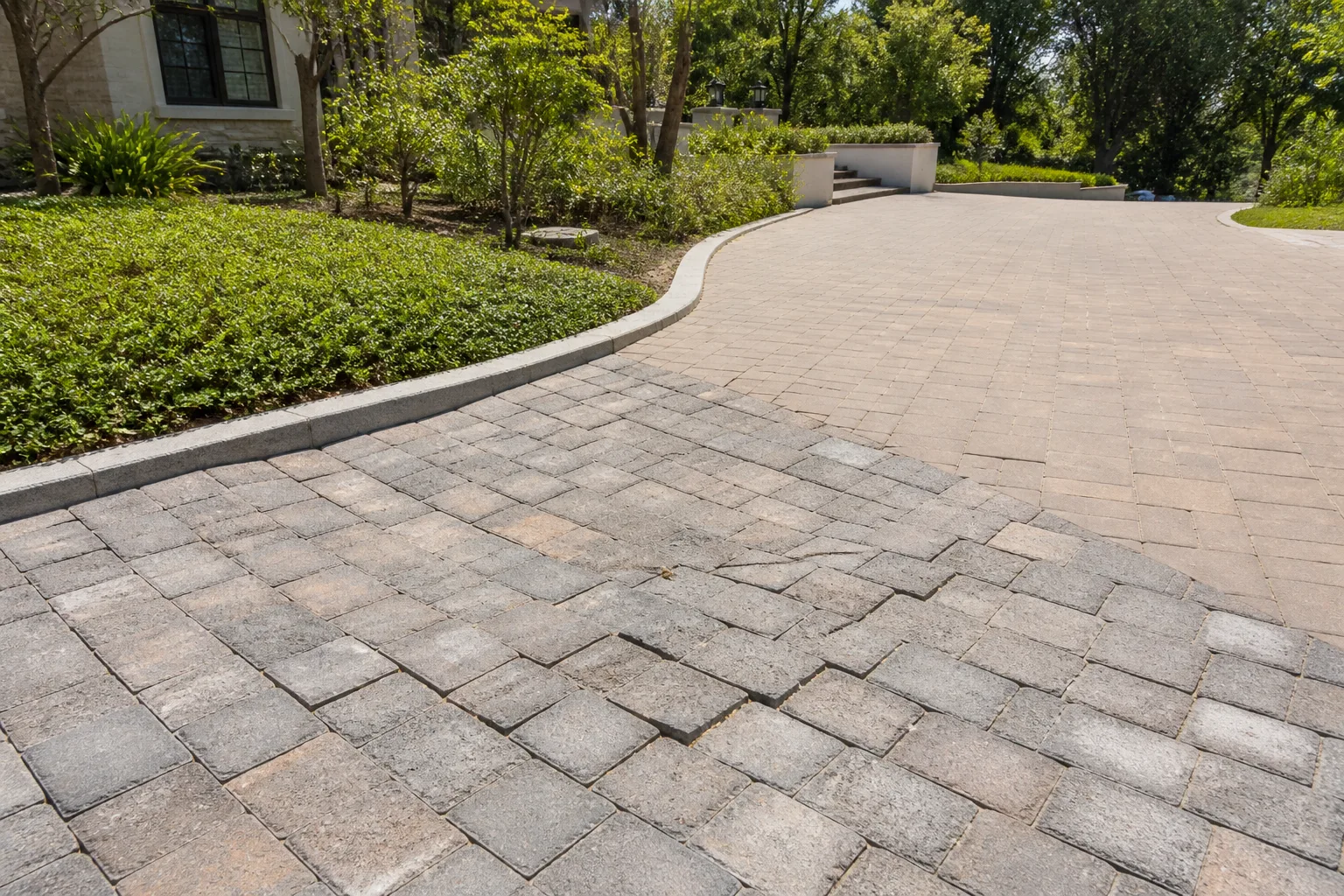
Driveway & Pavers: Repair or Replace? How Lake Forest Homeowners Decide
Most driveway paver decisions in Lake Forest get made on looks, and that’s the wrong test. Repair makes sense when the damage is surface-only and the base underneath is still holding. Replace makes sense when the base has moved, and roughly six of every ten repair calls we assess here turn out to be base failure wearing a surface disguise. If you’d rather not crawl around on your hands and knees to figure it out, call (855) 532-8973 and we’ll walk the driveway with you. Here’s how the call actually gets made.
Key Takeaways
- Paver appearance tells you very little. Base condition tells you almost everything.
- Three field tests any homeowner can run: the wobble test, the water pooling test, and the edge deterioration check.
- Once repair quotes pass about 40% of replacement cost, replacement wins on long-term value.
- Lake Forest’s clay-heavy soils fail differently than coastal sand or desert caliche, and the timeline reflects it.
- A proper assessment starts at the base, not at the pretty top layer.
Why does driveway damage in Lake Forest usually mean base failure?
Because the soils here don’t behave like they do on the coast. Much of Lake Forest sits on expansive clay that swells when it takes on water and shrinks as it dries. That cycle repeats every season. A paver driveway is only as stable as the compacted base and subgrade under it, and clay that moves twice a year will eventually unseat even a well-laid surface. We’ve pulled pavers out of driveways near the Foothill Ranch border where the surface looked fine from the street and the base was a loose, shifting mess an inch down.
This is the piece most homeowners never hear before they commit to a scope. A contractor who quotes a repair without opening the surface is quoting a guess. Surface fixes on a failing base buy you a season, sometimes two, and then you’re paying twice.
The distinction matters when you’re comparing quotes, because two bids can look identical on paper and represent completely different work. One resets a few pavers over a base that’s still sound. The other resets the same pavers and leaves the actual problem in place.
What are the three field tests for paver base failure?
You can get a reliable read on your own driveway in about fifteen minutes with no tools beyond a garden hose and your own two feet. These aren’t a substitute for a professional assessment, but they’ll tell you which conversation you need to have.
- The wobble test. Walk the full driveway and press down on the corner of each paver with the ball of your foot. A paver that rocks or clicks is sitting on a void. Voids form when the base compacts unevenly or washes out, and they spread. If you find more than a handful, that’s a base signal, not a cosmetic one.
- The water pooling test. Run a hose on a low setting and watch where water sits. Pavers should shed water toward the street or a drain. Standing water in the middle of the drive, or water that runs toward the house, means the grade has shifted underneath. That’s base movement, and it’s the one test result you shouldn’t ignore, because it puts your foundation at risk too.
- The edge deterioration check. Look at the perimeter where the driveway meets the lawn, the sidewalk, or the garage apron. Edges are where base failure shows first. Loose or missing edge restraint, sand washing out at the border, or pavers spreading outward all point to a base that’s lost its containment.
Two or more failing tests is worth a professional look. One failing test in a small area might genuinely be a repair.
What does base failure look like compared to surface-only damage?
The two problems leave different fingerprints, and once you know what to look for you can tell them apart from the sidewalk.
Surface-only damage looks like this: a stain that won’t come out, a chipped or cracked paver from a dropped tool or a heavy truck, faded color, or joint sand that’s thinned in a high-traffic strip. The pavers themselves are still locked together and sitting flat. Sand loss alone, especially along a tire path, is normal wear and it’s a cheap fix.
Base failure looks like this: pavers rocking in place, joints that open and close with the seasons, a driveway that dips in a bowl shape, sand that keeps washing out no matter how many times it’s refilled, edges spreading outward, or a step or lip forming where the driveway meets the garage or sidewalk. Soil movement patterns are the tell. Surface wear is even and gradual. Base movement is uneven and seasonal, and it gets worse after a wet winter followed by a dry summer, which is exactly the cycle Lake Forest runs through.
When you see the second set of symptoms, resanding the joints or swapping a few pavers is treating a symptom. The cause is still down there.
When does repair stop making financial sense in Lake Forest?
The number we use is 40%. When the repair quote climbs past about 40% of what a full replacement would cost, replacement becomes the better long-term spend. Below that line, a targeted repair is usually the right call, and we’ll tell you so.
Here’s the reasoning. A repair on a sound base fixes the actual problem and lasts. A repair on a failing base is a patch over a moving foundation, and it’ll be back. Paying 45% or 50% of replacement cost to buy two or three years is a bad trade, especially when the original surface is already past its service life.
What drives a repair quote toward that tipping point:
- Scope of the affected area. Replacing 15% of the driveway is a repair. Replacing 60% is a replacement with extra steps.
- Whether the base gets rebuilt. Lifting and resetting pavers is relatively cheap. Excavating, re-grading, and recompacting the base is most of the cost of a new driveway anyway.
- Matching materials. If you want a seamless look and the original paver line has been discontinued, patching with a close match can look worse than a fresh surface.
- Drainage corrections. If the fix requires re-grading to move water away from the house, you’re paying for base work regardless of what you call the project.
We give homeowners the line-item breakdown on both paths so the comparison is apples to apples, not a repair number against a replacement number that includes different scope. Upfront pricing, no surprises.
Why do Lake Forest soils change the repair-or-replace timeline?
Driveways in San Diego or Palm Desert deal with different ground than we do. Coastal installations sit on sandy, free-draining soils that stay relatively stable, so a paver driveway there can go a decade or more on its original base. Desert installs face caliche and extreme heat, which brings its own problems but not the seasonal swell-and-shrink cycle.
Lake Forest’s clay does something specific: it moves. Water infiltrates, the clay expands, and the driveway heaves. Summer dries it out, the clay contracts, and voids open under the pavers. Add the neighborhood grading that channels runoff, plus mature trees pulling moisture out of the soil on one side of the drive, and you get base failure that shows up faster than it would elsewhere.
That’s why “how long should a paver driveway last” doesn’t have one answer. On our soils, with our wet-winter-dry-summer pattern, the base condition matters far more than the calendar. We’ve seen eight-year-old driveways in the Portola Hills area that need base work, and older ones that are still solid because the grading was done right. The soil is the reason we start every assessment at the base.
What does a base-first assessment actually tell you?
It tells you which of two very different projects you’re actually buying. When we assess a driveway in Lake Forest, we start by pulling a paver or two from the worst area and looking at what’s underneath, checking the base thickness, testing compaction, and tracing where water is going. Only then do we look at the surface. That order matters because the surface is the last thing to fail and the least informative thing to look at first.
From there we can tell you honestly whether you’re looking at a repair or a replacement, and what the numbers are for each. Our technicians have up to 12 years of experience reading exactly this kind of failure, and the assessment is free. We use Belgard and Techo-Bloc pavers when a replacement is the right answer, and every project we finish is backed by the 730-Day Done Right Promise. If it’s not done right, we make it right, in writing, for two years.
We had a homeowner near the Lake Forest Sports Park call us for a “couple of loose pavers” last spring. Turned out the entire apron was sitting on eight inches of uncompacted clay because the original install skipped the base. Repair would have been a waste of money. She got a replacement with a properly rebuilt base and one of the densest pavers in the Belgard line under it. Five years from now that driveway will look the same.
When to call a pro
If your three field tests turn up rocking pavers, pooling water, or spreading edges across more than a small area, get eyes on it before you spend anything on repairs. Free estimates and a written line-item quote, live person on the phone any time, no voicemail loop. Call (855) 532-8973. And there’s currently $1,000 off projects over $10,000 with 0% financing for 18 months if a replacement turns out to be the right call.
Related services in Lake Forest: Driveway & Pavers in Lake Forest, and if your yard project runs to the property line, our Fence Installation in Lake Forest team handles the matching borders.
The Bottom Line
Repair or replace comes down to the base, not the surface. Run the three field tests, watch for the fingerprints of base failure (rocking pavers, pooling water, spreading edges), and let the 40% rule guide you on cost. If repairs cost more than roughly 40% of a replacement, replace. If your base is still sound, repair and save the money. Either way, get someone to open the surface and look before you sign a scope. If you’re in Lake Forest and need help, Groundwork Construction Co. of Lake Forest offers free estimates. Call (855) 532-8973 and we’ll give you the honest read, backed by our 730-Day Done Right Promise and background-checked, uniformed technicians on every job. When a full property refresh is on the table, our Home Additions & ADU in Lake Forest team can plan around the new driveway, and you can see everything we do on the Groundwork Construction Co. of Lake Forest home page.
Frequently Asked Questions
A targeted repair runs roughly $600 to $2,500 depending on square footage and whether the base needs work in the affected area. If the repair quote approaches the cost of a full replacement, replacement usually wins. Call (855) 532-8973 for an exact quote. Estimates are free.
Only if the base under them is still sound. Loose pavers over a compacted base are a genuine repair. Loose pavers over shifting clay will loosen again within a season or two. The three field tests above will tell you which situation you’re in, or we’ll tell you honestly during a free assessment.
No. We give you an upfront line-item price and the number you see is the number you pay. If we open the surface during a repair and find something the assessment couldn’t see, we stop and re-quote before touching anything else.
A properly installed driveway with a well-compacted base and correct drainage handles our clay soils for decades. One installed over an uncompacted or under-thickness base can start failing in eight to ten years. The base, not the calendar, decides. Call (855) 532-8973 to schedule your free estimate and get the real answer for your driveway.
Written by the team at Groundwork Construction Co. of Lake Forest.
Need Construction Help?
Call Groundwork Construction Co. of Lake Forest - licensed & insured, here with fast after-hours help in Lake Forest.
(855) 532-8973